Why Your Shipping Store Runs Differently Every Day -- And How to Fix It
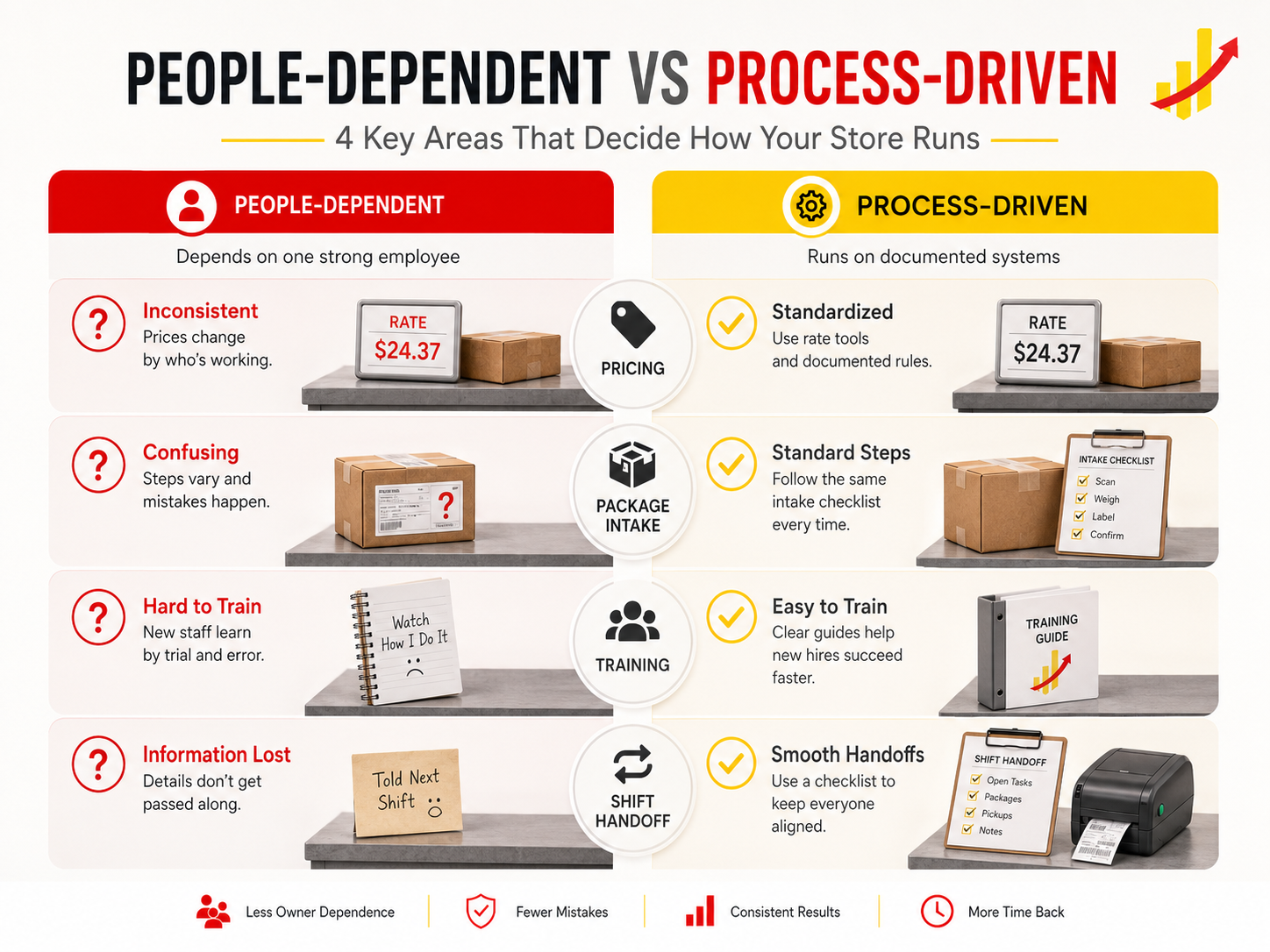
Most retail shipping store owners can describe their best employee in specific terms: that person knows the carrier rates, handles packing without being asked twice, quotes customers correctly, and rarely makes errors on package intake. They can usually also describe what happens when that employee is not there. The gap between those two versions of the same store is an operational problem -- and it is solvable.
The Real Cost of Operational Inconsistency
When store operations are tied to specific individuals rather than documented processes, the costs show up in several ways:
Customer experience variance. A customer who was quoted one price on Monday and a different price on Thursday loses confidence in the store. That confidence is difficult to rebuild and often does not get a chance to: the customer simply starts using a different location.
Package intake errors. Packages measured before packing is complete, dimensions entered inconsistently, weight recorded before materials are added -- these are the inputs that drive carrier billing adjustments. Most carrier adjustment problems are rooted in intake process failures, not carrier error.
Training cycle length. When processes are not documented, new employees learn from other employees -- which means they learn whatever habits, shortcuts, and inconsistencies the current team has accumulated. The training period is long, the error rate is high, and the outcome varies depending on who trained whom.
Owner dependence. A store that runs well only when the owner is present is a store with an operational ceiling. It limits hours, limits scalability, and significantly limits the store's value at sale time.
What Documented Store Operations Actually Look Like
An effective SOP package for a retail shipping store is not a thick policy manual. It is a collection of specific, task-level documents that tell an employee exactly what to do at each stage of the counter workflow, in enough detail that someone with no prior experience can follow it correctly.
The core documents most stores need include:
Package intake checklist. Step-by-step process for receiving, measuring, and pricing a shipment -- including when to measure, what dimensions to record, and how to handle irregular items.
Carrier-specific workflows. Each carrier has different processes for drop-off, system entry, receipt printing, and staging. Documenting these separately eliminates the confusion that comes from mixing carrier procedures.
Mailbox intake process. Form 1583 collection, ID verification, system setup, and mailbox assignment -- documented in order, with compliance requirements integrated into the workflow rather than treated as a separate checklist.
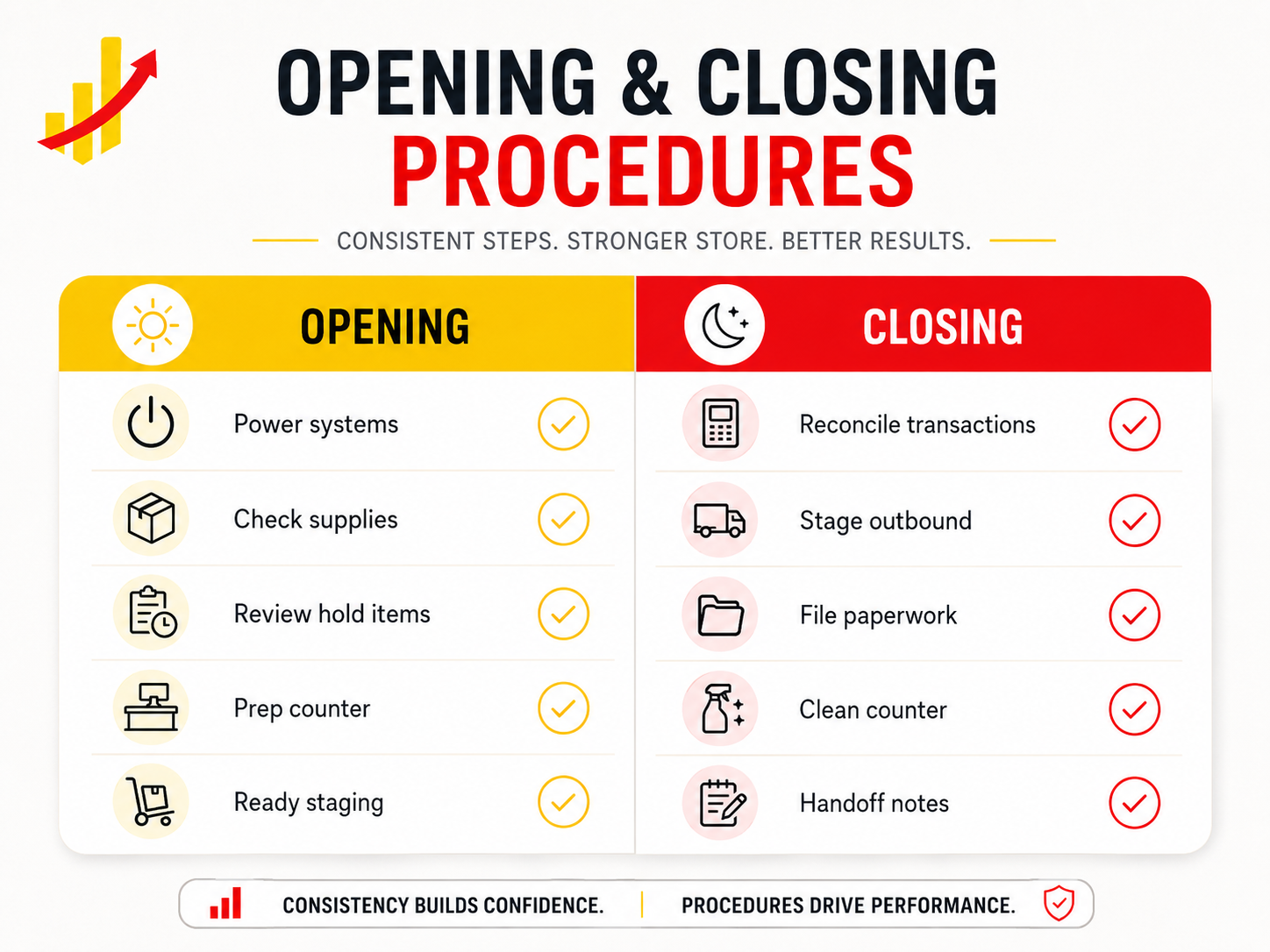
Counter opening and closing procedures. What needs to happen at the start and end of each shift, including reconciliation, staging for the next day, and handoff documentation.
New hire training sequence. A structured 2-to-3-week training plan that takes a new employee through each documented process in a deliberate order, with sign-off milestones.
The Ownership Independence Test
A useful benchmark for operational maturity is whether the store can run correctly for a full week without the owner present. Not just open and take transactions -- run correctly, with accurate intake, proper pricing, compliant mailbox handling, and clean end-of-day processes.
For stores that cannot pass that test, the gap is almost always documentation, not talent. The employees are capable; the processes are in their heads rather than on paper.
Frequently Asked Questions
How long does it take to build and implement an SOP package for a retail shipping store?
Building the initial documentation typically takes 4 to 6 weeks, working with the current team to capture what is being done correctly and standardize it. Implementation and training typically takes another 4 to 8 weeks before the new processes are running consistently.
Do documented SOPs reduce employee flexibility?
Not meaningfully. Documentation covers what needs to be consistent -- intake, pricing, compliance, handoff. It does not script customer interactions or remove judgment from complex situations. The goal is consistency in process, not uniformity in personality.
What does this have to do with store value?
Significantly. A buyer acquiring a store where operations are dependent on the current owner is acquiring operational risk. A store with documented, transferable processes is a more valuable and more financeable acquisition. --- If your store runs differently depending on who is working, the solution is not to find better employees -- it is to build better systems. Request an operations evaluation at RetailShippingConsultants.com.
For stores that cannot pass that test, the gap is almost always documentation, not talent. The employees are capable; the processes are in their heads rather than on paper.