Why Most Shipping Store Owners Do Not Know Their Real Profit Margin
Revenue is easy to track. Profitability by service category is where most independent shipping store owners have a significant blind spot -- and that blind spot has real consequences for pricing decisions, staffing, and the long-term value of the business.
The Difference Between Revenue and Owner Benefit
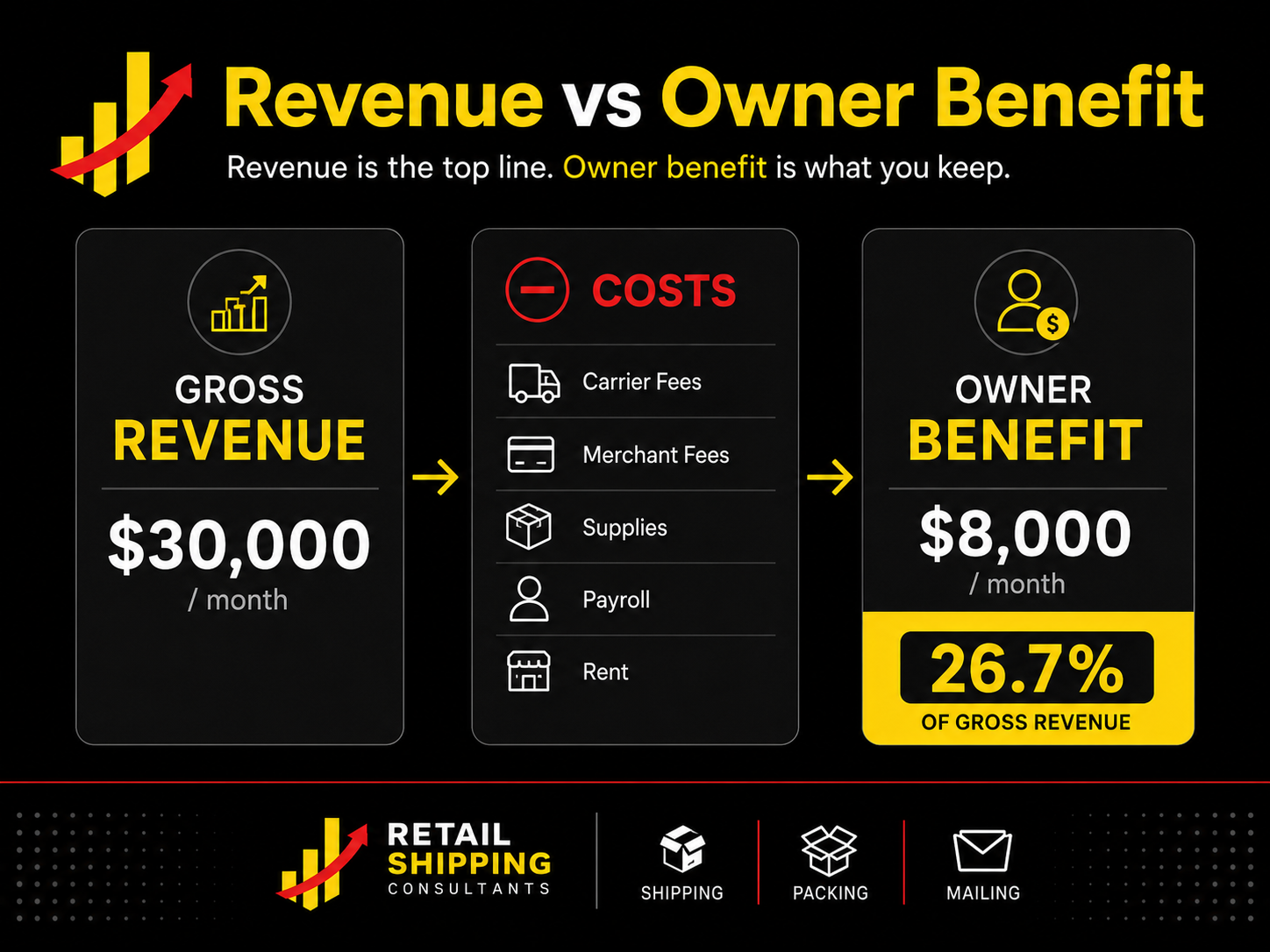
When a retail shipping store owner says their store "makes $30,000 a month," that number almost always means gross revenue. What it rarely accounts for is the cost structure layered underneath it -- carrier fees and adjustments, merchant processing costs, supply costs, payroll, and rent.
True owner benefit is the amount the owner actually takes home after all business expenses have been paid, including any owner salary that was running through the business. This is the number that determines what a store is actually worth and whether the business model is sustainable at its current service mix.
In well-run retail shipping stores, owner benefit as a percentage of gross revenue typically falls in a specific range. Stores that fall significantly below that range often have one or more underpriced services, unmonitored recurring costs, or a service mix that generates volume without proportional margin.
Why Service-Level Margin Analysis Changes Decisions
Not every service in a shipping store is equally profitable. Mailbox revenue -- particularly at stores with stable, long-term mailbox customers -- often represents the highest-margin revenue in the store because it generates recurring income with relatively low variable cost. Packing and freight services can carry strong margins when priced correctly. Standard carrier shipping competes on convenience and tends to carry tighter margins due to carrier rate structures.
When owners understand margin by service category, pricing decisions become clearer. A store that is significantly underpriced on notary services, for example, is leaving clean margin on the table. A store that is heavily concentrated in low-margin carrier volume may need to rebalance toward higher-margin services to improve profitability without necessarily growing total revenue.
What Clean Books for a Retail Shipping Store Actually Look Like
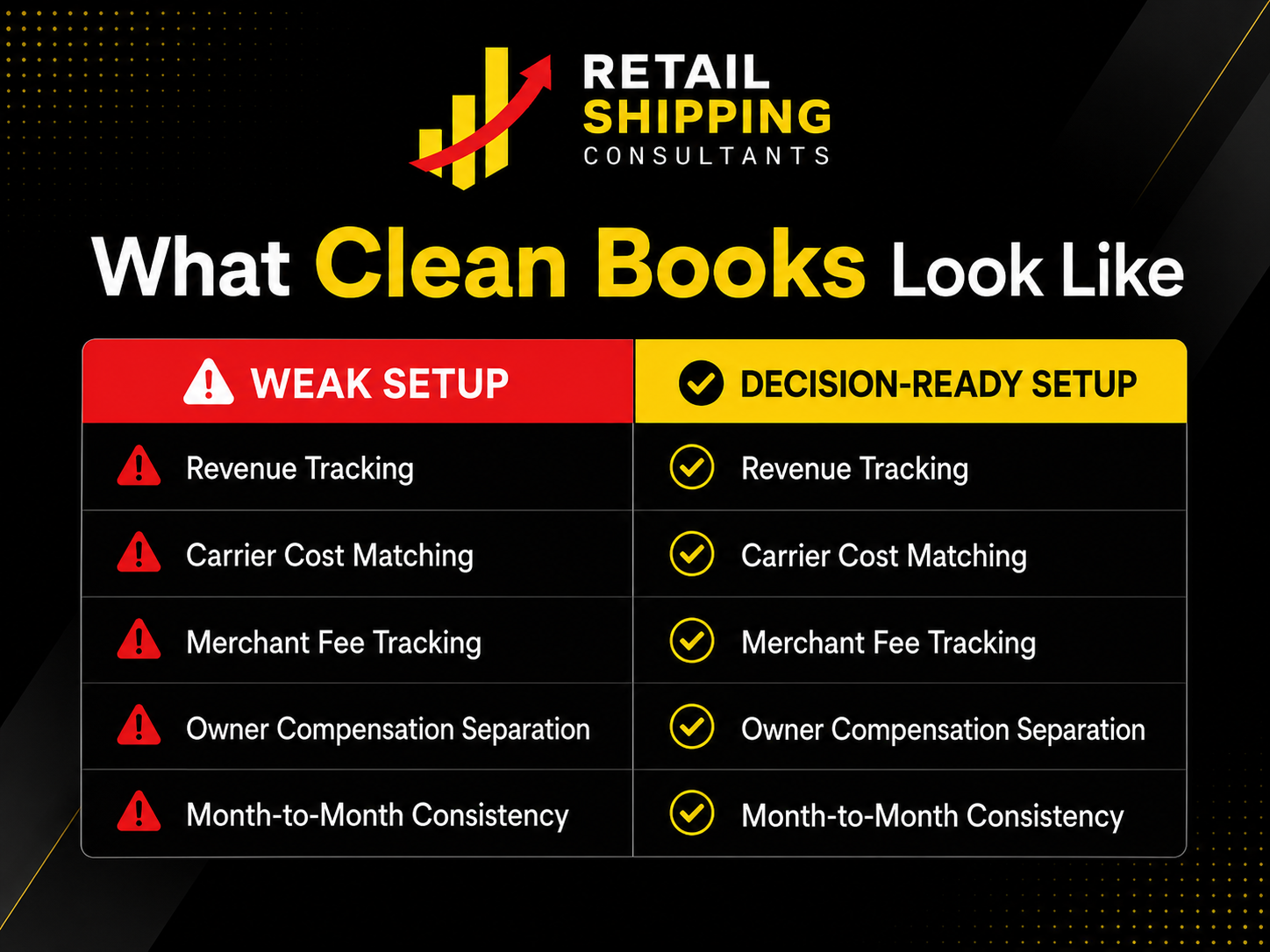
Clean financial records for a shipping store are not simply about bookkeeping accuracy -- they are about categorization. Many stores keep books that are accurate but not useful: revenue is tracked as a single line item, costs are grouped in ways that make service-level analysis impossible, and owner draws are commingled with business expenses in ways that make owner benefit difficult to calculate.
For a store that is planning to sell, seeking financing, or simply trying to make better operating decisions, the books need to tell a specific story:
- Revenue broken out by service category
- Carrier costs matched to carrier revenue
- Merchant processing fees tracked separately from other operating costs
- Clear separation between owner compensation and business expenses
- Consistent month-over-month categorization that enables trend analysis
Getting there from a less structured starting point typically takes two to three months of cleanup work. The payoff is a clearer understanding of where the store actually makes its money -- and a significantly stronger position if the store ever goes to market.
Frequently Asked Questions
What is a typical profit margin for an independent shipping store?
Owner benefit as a percentage of gross revenue varies significantly by store, but well-run independent retail shipping stores generally target owner benefit in the range of 20 to 35 percent of gross revenue. Stores below that range typically have pricing gaps, unmonitored costs, or a service mix problem.
How do I calculate real owner benefit for my store?
Start with gross revenue, subtract all operating expenses including carrier costs, payroll, rent, and supplies. Then add back any owner salary that was expensed through the business. The resulting number is owner benefit -- the true economic return to the owner.
Why does service-level margin analysis matter if my overall profitability looks acceptable?
Overall profitability can mask significant margin leaks in specific service categories. A store with acceptable aggregate margins may still be underpriced on its highest-volume service, which means growth is actually making the problem worse rather than better. --- A professional bookkeeping and margin review is one of the fastest ways to understand your store's true financial position. Request an evaluation at RetailShippingConsultants.com.
Getting there from a less structured starting point typically takes two to three months of cleanup work. The payoff is a clearer understanding of where the store actually makes its money -- and a significantly stronger position if the store ever goes to market.