Is Your Shipping Store CMRA Compliant? What Every Independent Owner Needs to Know

Retail shipping stores that accept mail and packages on behalf of customers are classified as Commercial Mail Receiving Agencies (CMRAs) under federal postal regulations. Operating as a CMRA comes with specific legal obligations that many independent store owners either misunderstand or are simply unaware of -- and the consequences of non-compliance can range from customer disputes to regulatory scrutiny.
What Is a CMRA and Why Does It Matter?
A Commercial Mail Receiving Agency is any business that receives mail on behalf of another person or business and makes that mail available to the addressee. If your store offers mailbox services, you are a CMRA -- regardless of whether you actively market it that way.
CMRA status triggers specific obligations under U.S. Postal Service regulations, most importantly the requirement to collect and verify Form 1583 (Application for Delivery of Mail Through Agent) for every mailbox customer. This form must be notarized or completed with two forms of acceptable identification and kept on file for a defined period.
The Form 1583 Gap Most Stores Have
Many stores have some Form 1583 documentation on file -- but incomplete, expired, or improperly executed forms carry the same compliance risk as no forms at all. Common gaps include:
- Forms that are missing one of the two required forms of identification
- Forms with photocopied ID instead of original or verified copies
- Expired forms that were never renewed when customers renewed their mailbox contracts
- Forms missing notarization in states where it is required
- Customers receiving mail under business names not listed on their Form 1583
An audit of your mailbox compliance records often reveals that a meaningful percentage of active mailbox customers have deficient documentation. Resolving those gaps proactively is significantly less disruptive than addressing them reactively.
The Commercial Receiving Depot (CRD) Requirement
Beyond Form 1583, stores operating as CMRAs are subject to Commercial Receiving Depot rules, which govern how mail is accepted, stored, and held for customers. CRD requirements include proper disclosure to customers about CMRA status and addressing standards that ensure mail addressed to the store does not appear to originate at a residential or non-commercial address.
These requirements matter because USPS enforces them, and carriers can refuse to deliver mail to a CMRA that does not meet CRD standards. In more serious cases, customers can initiate legal action if they can demonstrate they were not properly disclosed as receiving mail through an agent.
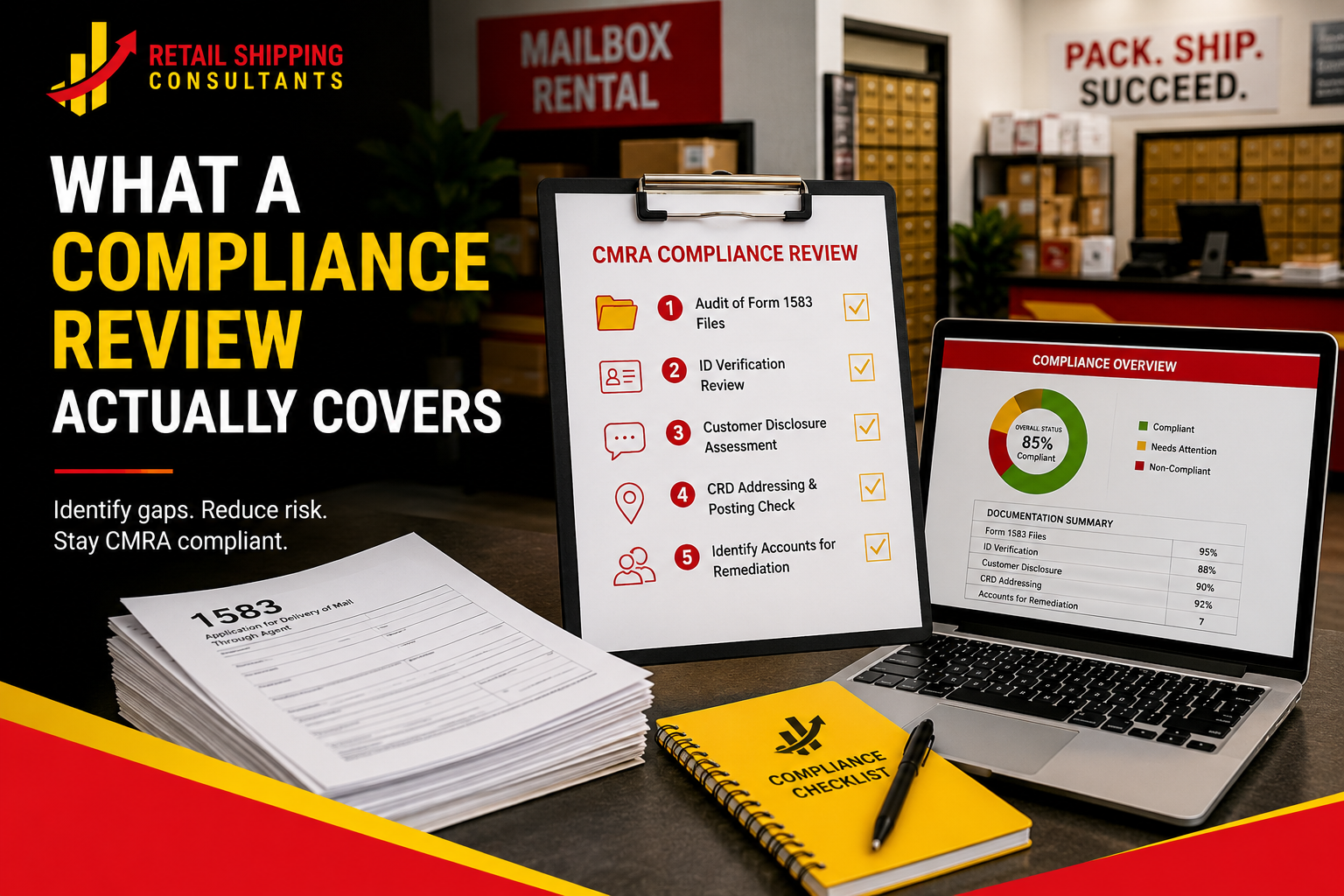
What a Compliance Review Actually Covers
A structured CMRA compliance review for an independent shipping store typically includes:
1. Audit of all active Form 1583 files for completeness and currency
2. Review of ID verification documentation against acceptable identification standards
3. Assessment of customer disclosure language on mailbox agreements and signage
4. Check of CRD addressing and posting requirements
5. Identification of customers whose mailbox accounts need remediation before the next renewal cycle
Most stores that complete a compliance review discover a mix of procedural gaps and missing documentation. The goal is to identify those gaps on your own terms -- before a carrier audit, a difficult customer situation, or a regulatory inquiry forces the issue.
Frequently Asked Questions
What happens if a CMRA does not have a valid Form 1583 on file for a mailbox customer?
The store is potentially liable for delivering mail to an unverified party. USPS can direct carriers to stop delivering mail to that customer, and the store may face consequences for violating CMRA regulations. Proactive compliance is significantly lower risk than reactive remediation.
How often does Form 1583 need to be renewed?
Form 1583 does not expire on its own, but it must be updated whenever a customer changes their name, adds a business name to their mailbox, or the documentation on file no longer accurately reflects who is receiving mail at that address.
Do small stores with only a few mailboxes still need to comply?
Yes. CMRA compliance requirements apply regardless of the number of mailbox customers. There is no minimum threshold. --- If you are not confident in the completeness of your CMRA compliance documentation, a professional compliance review is the fastest way to understand your current position and close the gaps before they become a problem. Request an evaluation at RetailShippingConsultants.com.
Most stores that complete a compliance review discover a mix of procedural gaps and missing documentation. The goal is to identify those gaps on your own terms -- before a carrier audit, a difficult customer situation, or a regulatory inquiry forces the issue.